Precigeon
There is no page two in a ChatGPT answer. A store is either in it, or it doesn't exist.
scroll to read · skip to the designs
scroll to read · skip to the designs
AI visibility for Shopify stores. Paste a store URL and Precigeon asks the four big assistants the questions customers actually ask, then shows where the store stands, receipt by receipt, and what to fix first.
Shopping advice is moving into chat windows, and merchants can't see any of it. An AI answer names three to five brands. No ranking to climb, no console to check. Every owner I interviewed watched Google daily; none had ever seen an AI answer about their store.
A free scan with zero setup: paste a URL, install nothing. Fifteen minutes later there's a real report: linked, mentioned or missing, with the actual answers behind every number.
The MVP is live at precigeon.com and ten Shopify store owners are running it on real catalogues right now. The only file here still being written while it happens.
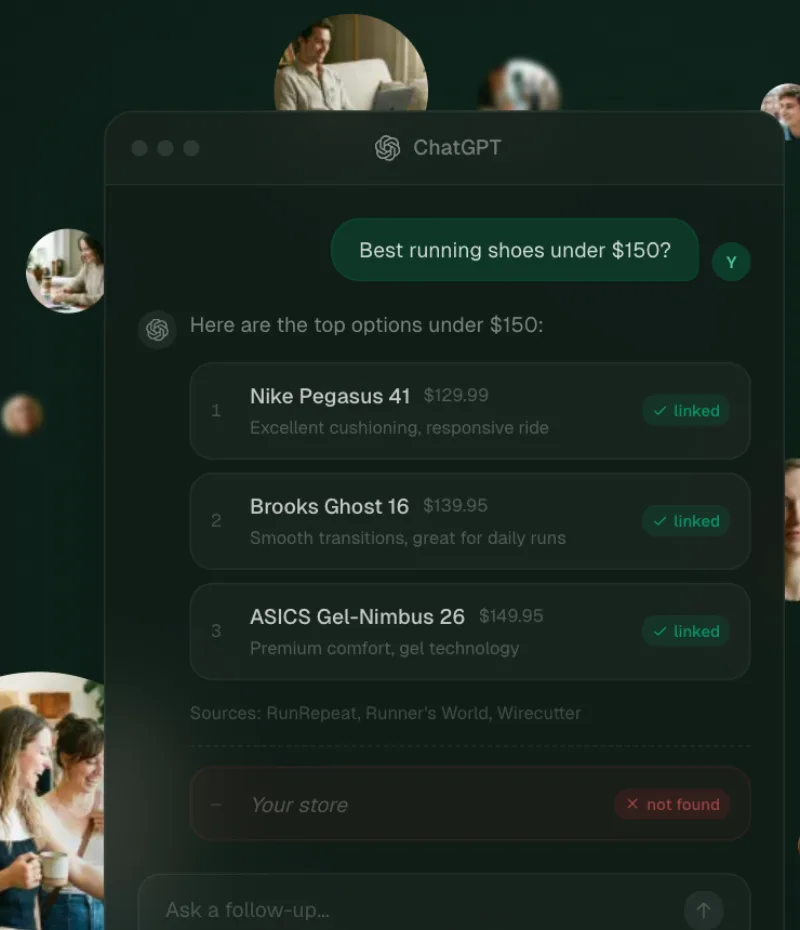
Ask ChatGPT for the best running shoes under $150. It names three. It may not name you.
The public numbers sketch the shift: roughly a third of shoppers already research products with AI tools, and an AI answer names three to five brands, not a results page. What the numbers don't say is whether merchants can see any of it. So I asked:
The whole problem in one window: an AI answer has a handful of seats and no page two. You hold one, or you don't exist.
"Honestly, no idea if I show up at all. I know my Google position for twenty keywords. For the AI stuff I'm blind."
A no-name side project can't open with an install prompt. The wedge gives value before it asks for anything.
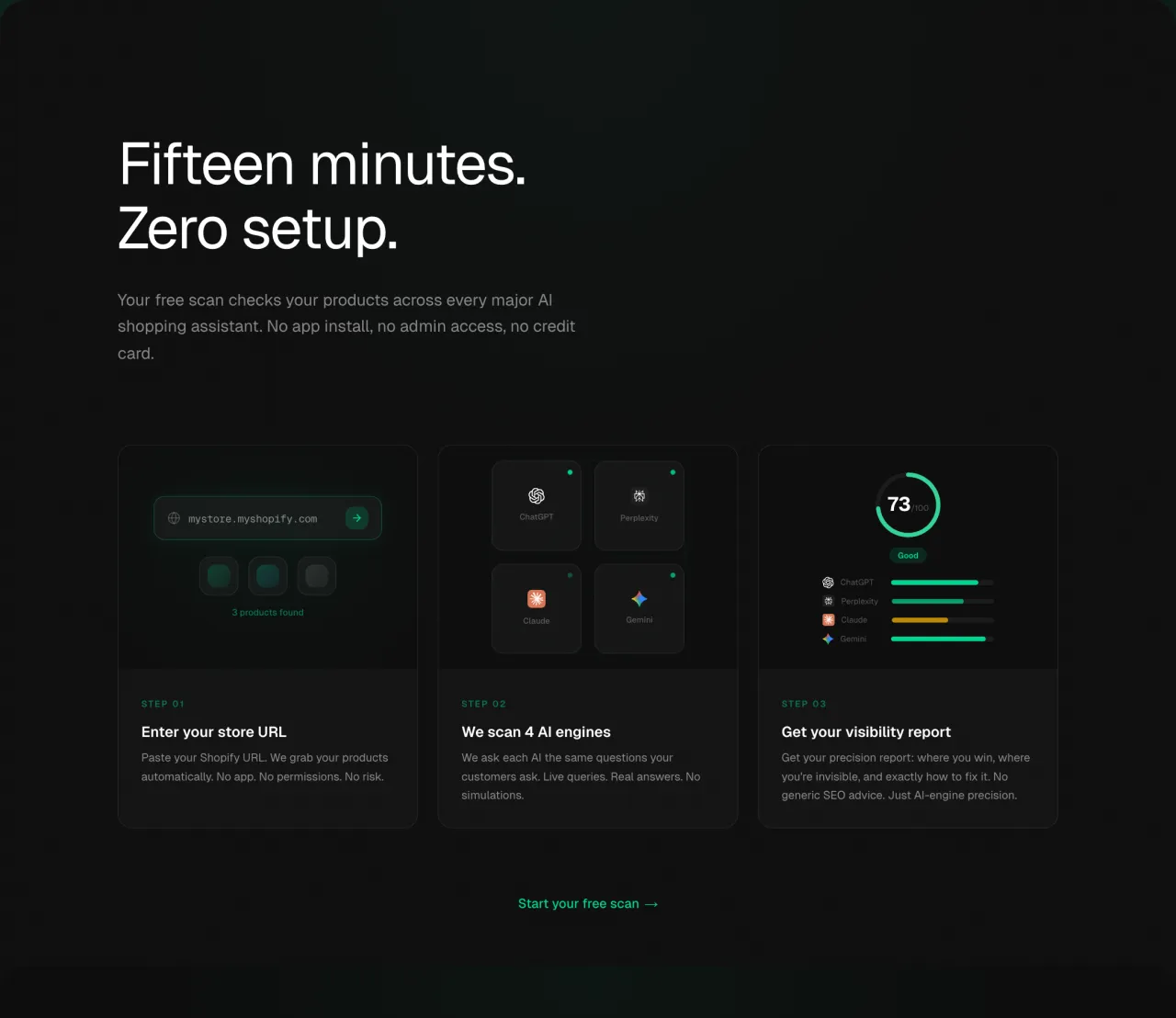
The spine is the free scan: paste a URL, get a real answer in about fifteen minutes, install nothing, grant nothing. It runs live queries against the four assistants, asking the same questions a customer would ask, and shows where the store is linked, where it's only mentioned, and where it doesn't exist.
The scan isn't a teaser, it's the proof, and the report has to hurt a little. Competitors named in an answer where your store is missing does more selling than any feature list. What's held back is the ongoing part: monitoring, rewrites, tracking.
The wedge, drawn: nothing installed, nothing granted. Live questions in, receipts out, about fifteen minutes end to end.
An install and permissions before any value, from a brand nobody knows. Dead top of funnel.
Proves the value but scales like an agency, which is to say it doesn't.
Paste a URL, wait fifteen minutes, see the truth. The report becomes the sales pitch.
Why: everything a scan needs is public: the catalogue, the descriptions, the answers the AIs give. Asking for nothing removes the excuse to bounce. The app install can come later, where it unlocks something real: one-click fixes need write access, seeing the truth doesn't.
One rule set the whole design system: no number without the receipt behind it.
The report is the product, so the design work went into making a strange new metric feel concrete instead of mystical. The score breaks down per engine, each engine per product, and every product opens into the actual prompts and answers it appeared in, or missed.
Visibility gets three states, linked, mentioned and not found, because being talked about and being bought from are different things. One green, spent on exactly one meaning: found. Amber for mentioned. Red reserved for the empty seat where the store should be.
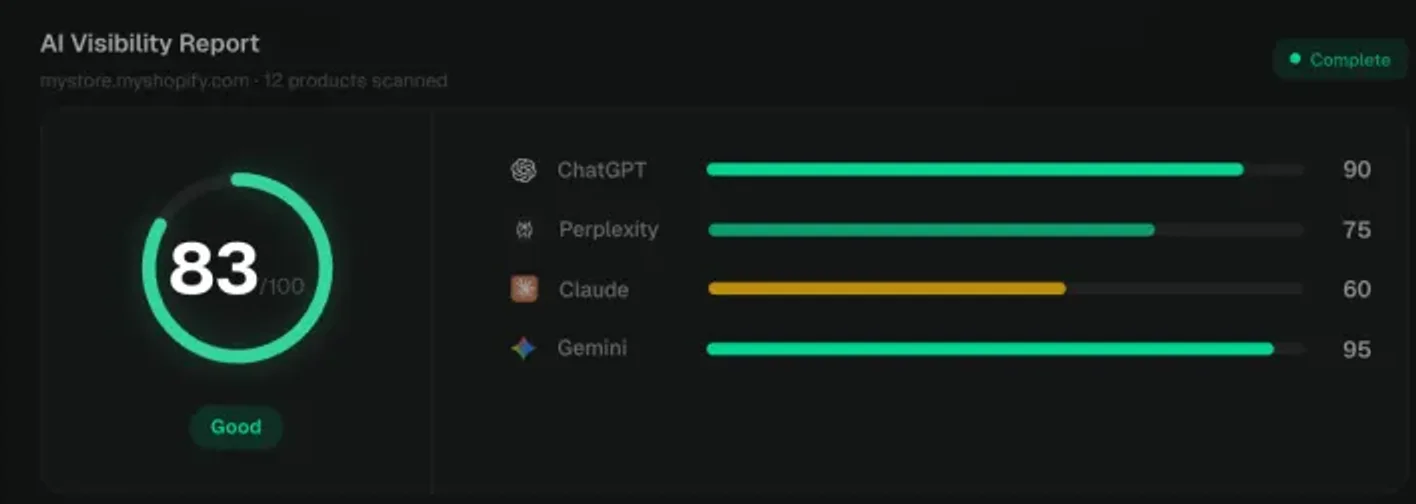
A single number hides exactly the thing a merchant needs: where they lose.
Honest but unreadable. Nobody diffs transcripts every week.
The number covers the Monday glance; the prompts and answers behind it cover the doubt.
Why: a score gets glanced at, receipts get believed. When the number drops you can open the exact prompt and answer that moved it, so the tool never asks to be trusted on faith. AI answers also shift on their own, and a score you can interrogate survives that better than one you can't.
live at precigeon.com, the whole funnel is one field
Paste your store URL. Everything on the page exists to make that one action feel safe (no install, no permissions, no card) next to a ChatGPT window with the one seat your store isn't in. The landing and the scan are live; they're the wedge doing its job today.
everything you need at one place
One score, then the argument for it: per-engine bars, the trend since last week, the alert when something drops, and a do-next list sorted by leverage. Built for a thirty-second Monday check, not a data dive.
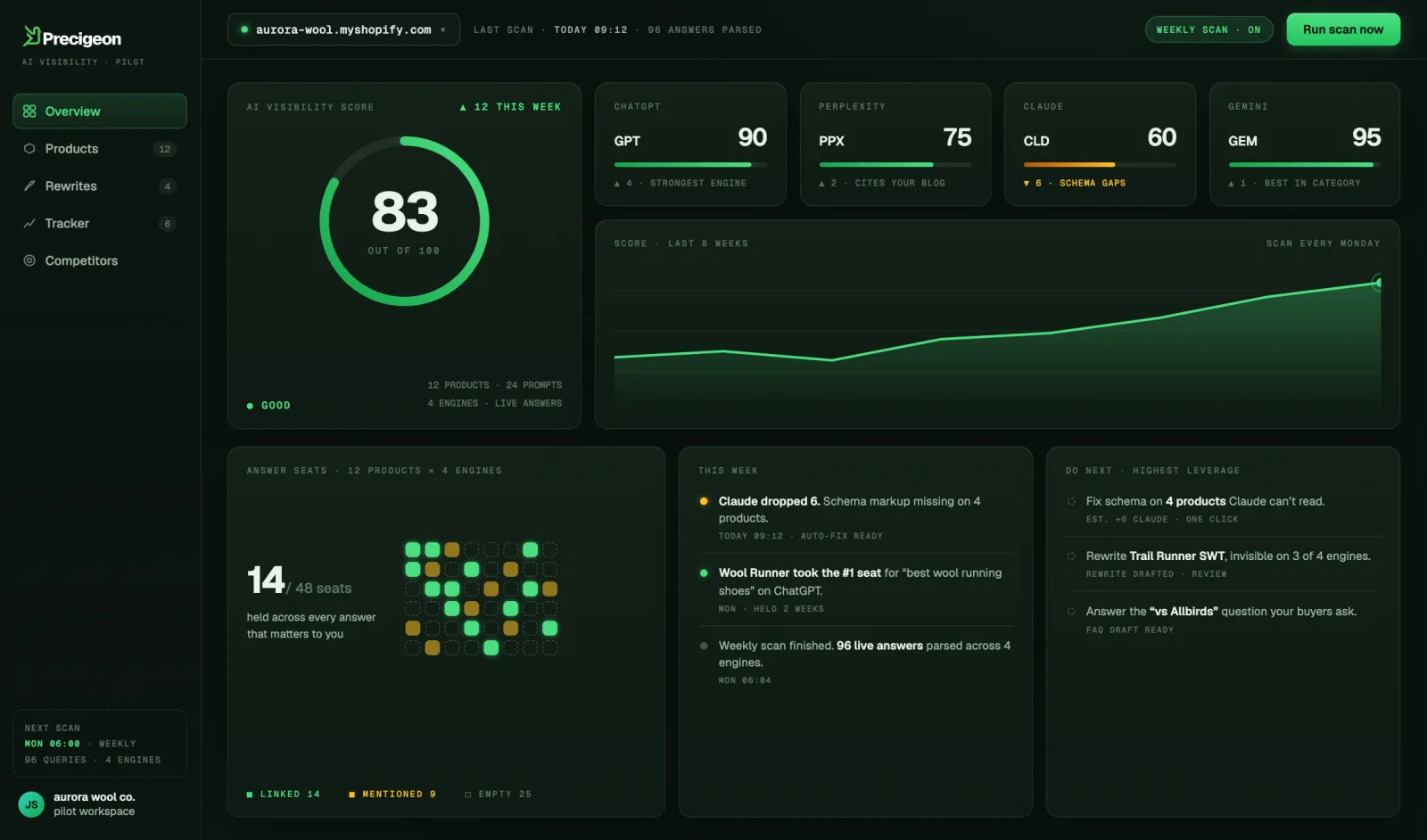
the screen that hurts and helps
Products down, engines across, three states in the cells: exactly which products are invisible, and where. Sorted by not-found, it stops being a chart and reads as a to-do list, with the fix one click to the right.
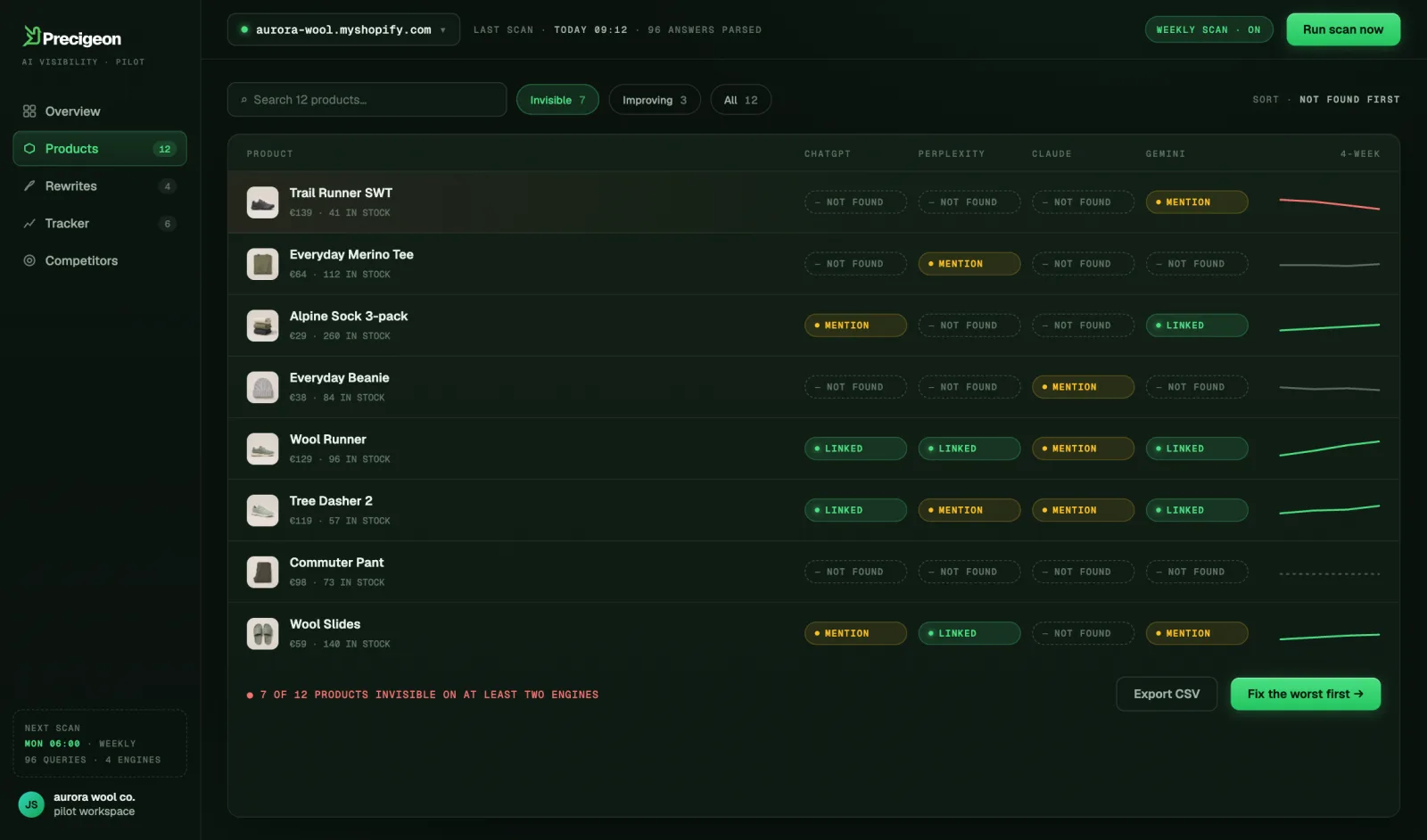
engines match specifics, not vibes
The fix half. The rewrite sits next to what's live now, with the reason it should work spelled out: engines quote material, process and use case, so the rewrite adds exactly that, phrased the way buyers ask. One click pushes to Shopify, and nothing publishes silently: you review, it ships.
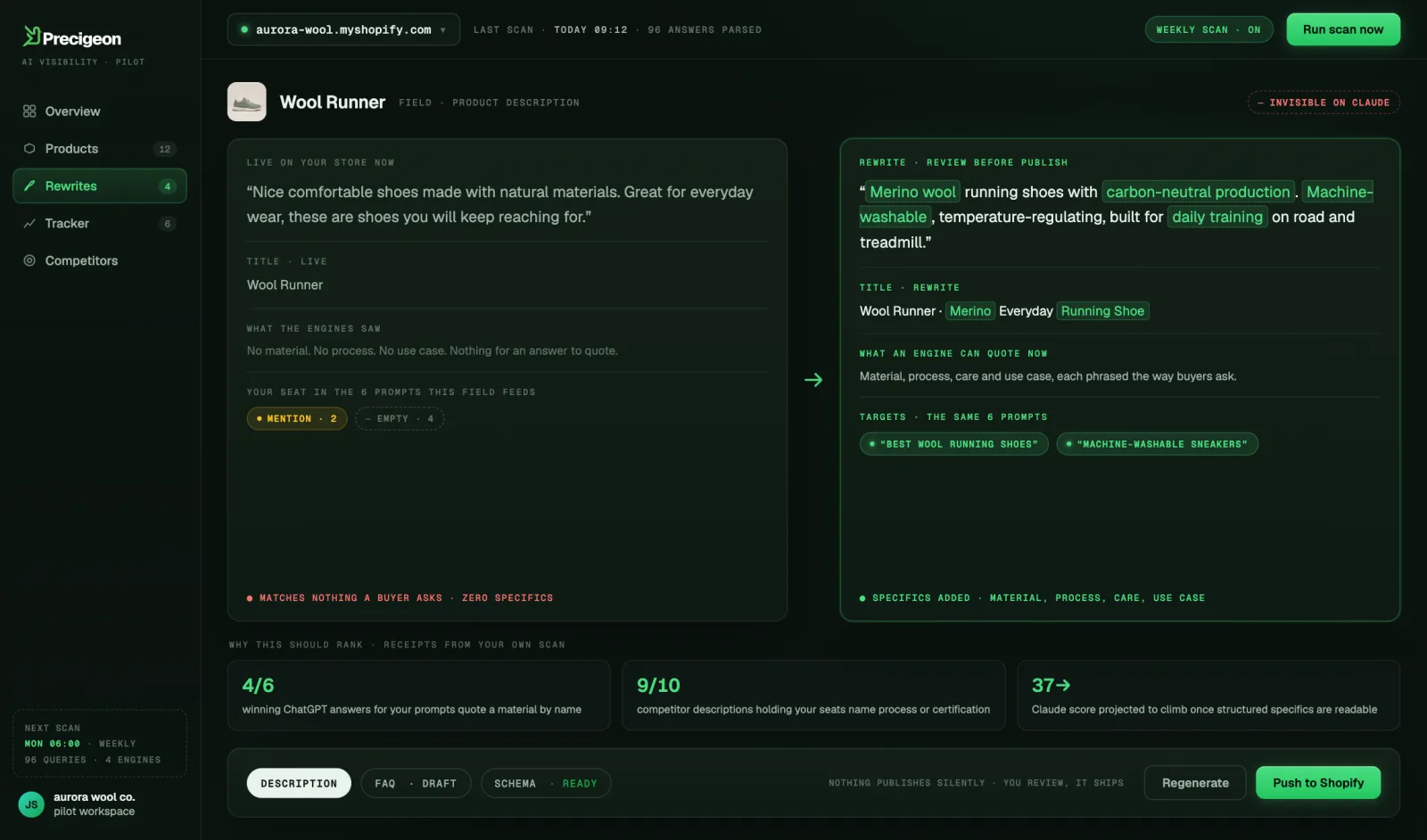
the screen that turns an audit into a habit
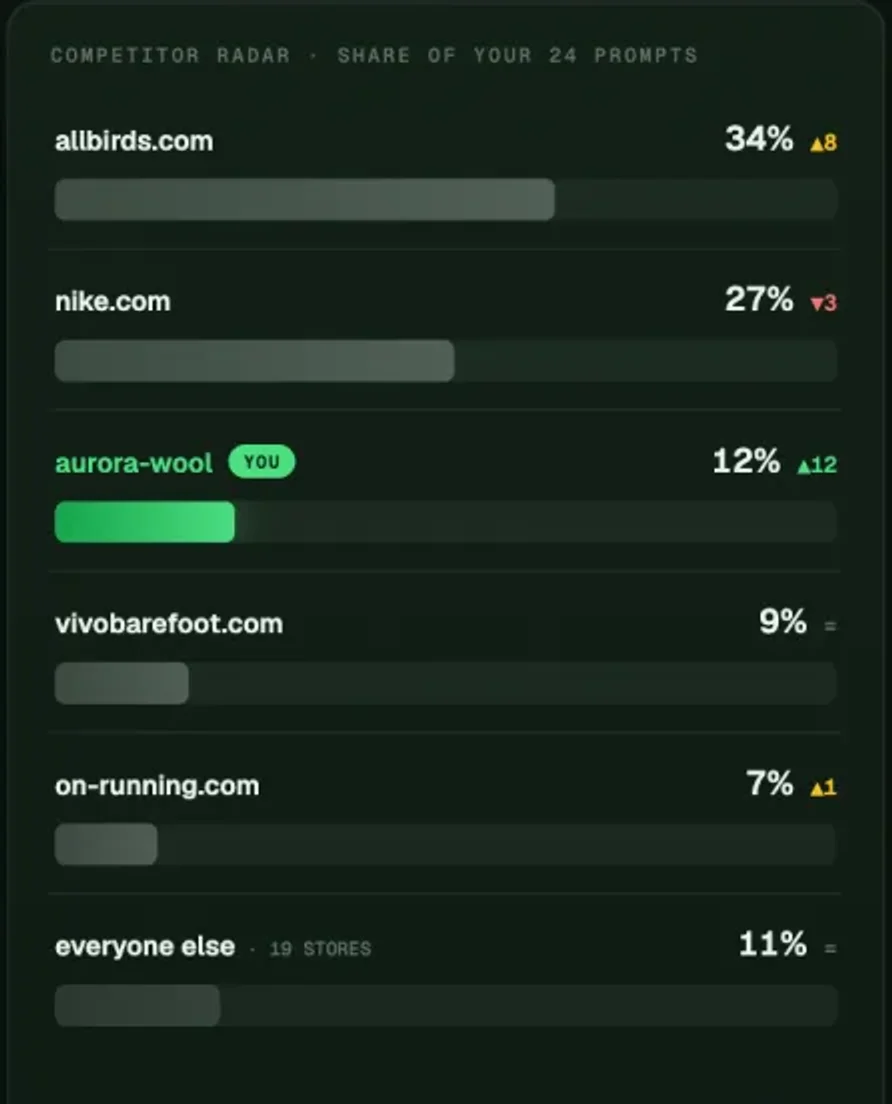
Prompts and competitors, week over week: your position per engine per query, and who holds the seat you want. This is the screen the platform bets on, the one that turns a one-off audit into a Monday ritual, and the pilot's job is to prove that turn happens.
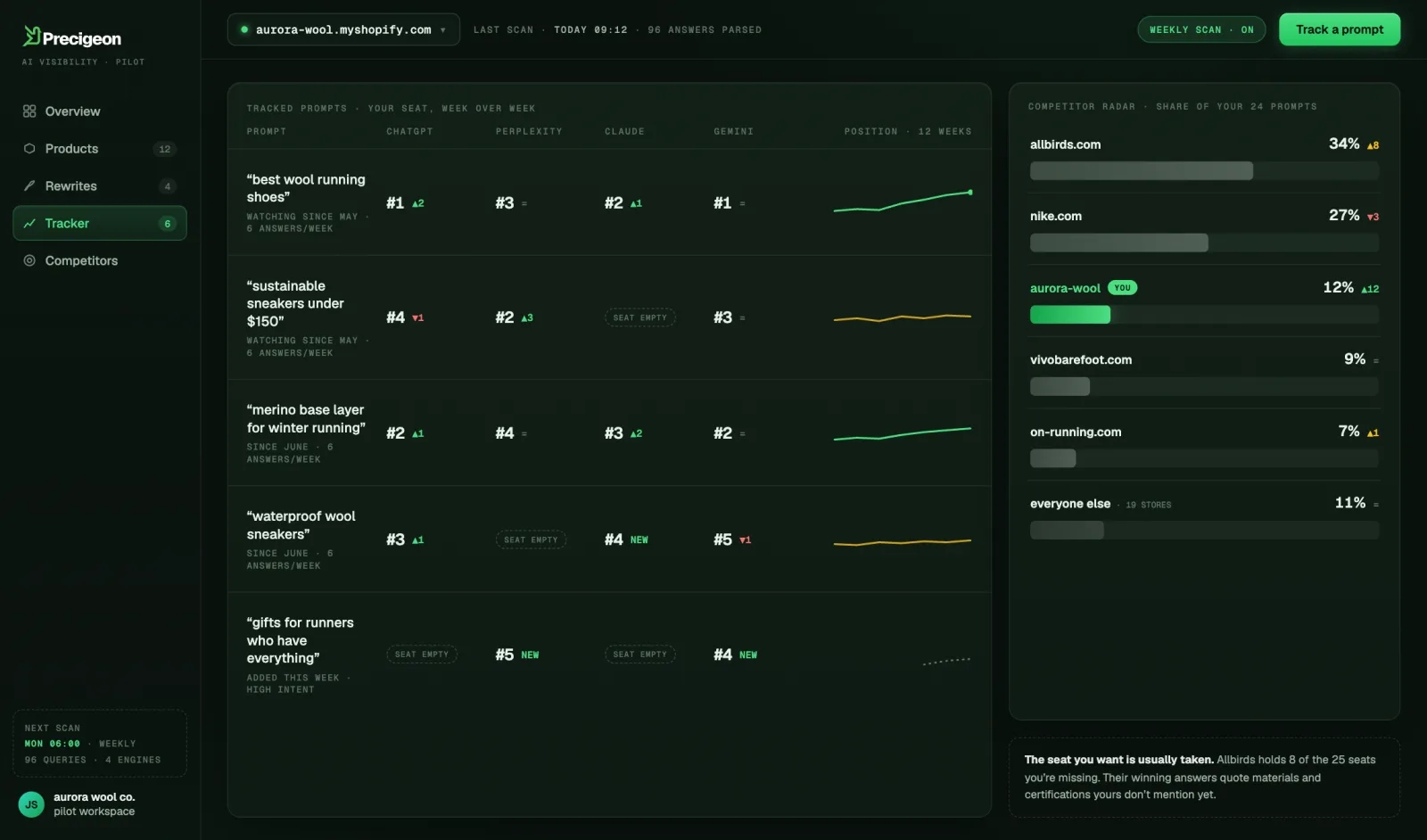


The MVP is the wedge end to end, live at precigeon.com, ten real stores scanning right now.
Recruiting ten store owners was its own small validation: the pitch that worked wasn't a feature list, it was one question. The pilot they joined is built to answer three things:
Do merchants read the report, or glance at the score and move on? The receipts exist for the doubters; the pilot shows if doubters open them.
Does anyone apply a fix? The rewrite is one click, but one click is still a decision made on a new kind of number.
Do the answers move, within weeks, not quarters. The loop the whole platform bets on. Moved answers land in this file first, when they're real.
"Do you know what ChatGPT says about your store?"
01
Sell with receipts, not adjectivesThe report has to hurt a little. Competitors named in an answer where your store is missing did more selling than any feature list, and every number that could be doubted opens into the prompt and answer behind it.
02
Ask for nothing before you give somethingEverything the scan needs is public: the catalogue, the descriptions, the answers. Zero setup removed every excuse to bounce, and made a no-name side project worth fifteen minutes of a stranger's trust.
03
A score you can interrogate survives volatilityAI answers shift under your feet, so a visibility score has to be read like weather, not geology. A number that unfolds into receipts survives that. A black-box number wouldn't.
Ten stores can see it now. Proving a fix is what moved it comes next.
Cause, not just movement: the tracker shows a seat changing hands. It can't yet say your rewrite is why. Answers drift on their own, which the score is built to admit, so the next thing has to hold a prompt steady around a change and read the before and after as one story instead of two.
Every store, not just Shopify: the scan only ever needed a public URL, so the half that tells the truth already works anywhere. It's the half that ships the fix that is Shopify-shaped. Splitting those apart is what turns a Shopify tool into an AI visibility tool.
The answer that moved: the one number that would prove the whole thesis, and the one I don't have yet. A merchant ships a fix, the engines re-answer, the seat changes hands. It goes in this file the week it happens, and not a week before.
Ten store owners can now see a thing that was invisible a month ago. The file stays open, and the next entry is an answer that moved.